The City's stock of affordable housing units are aging as new developments struggle to keep up with an expanding demand.
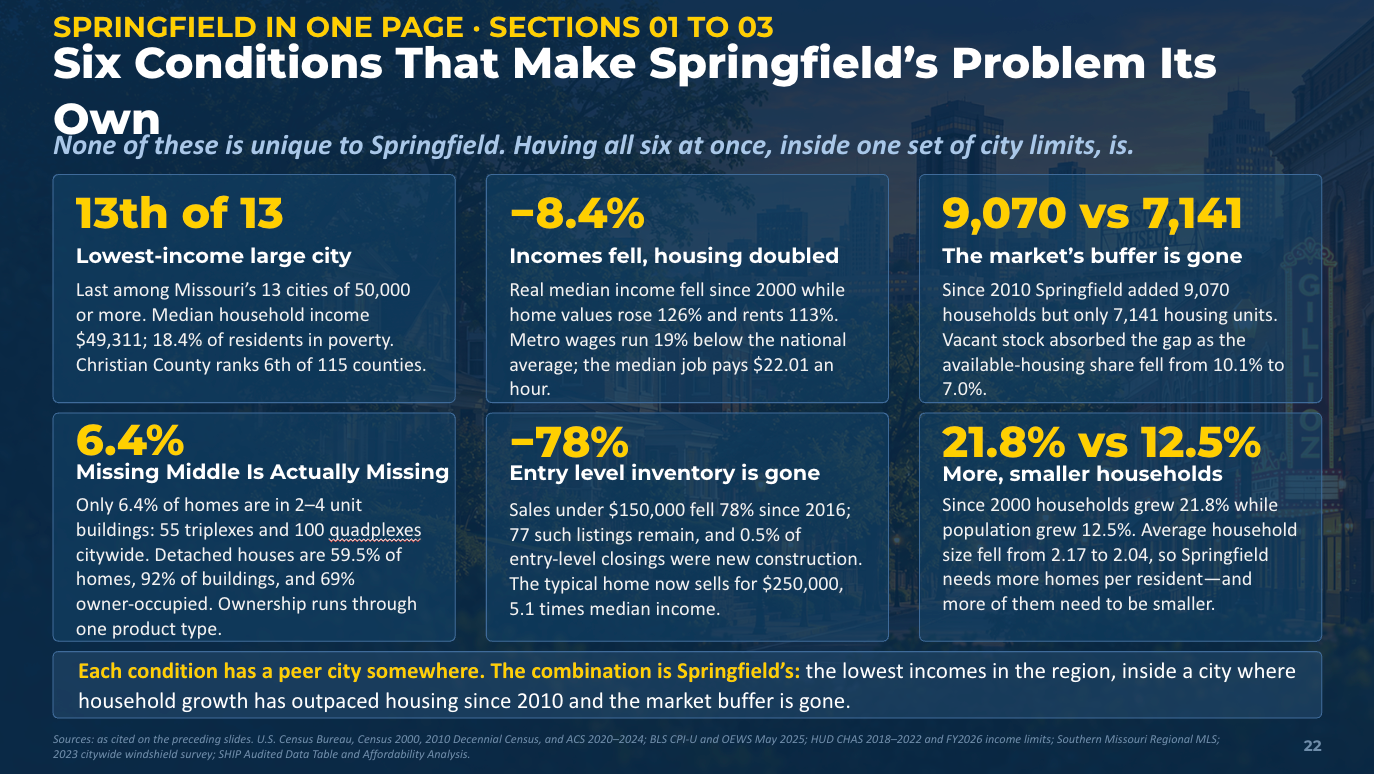
In the City of Springfield, rental costs and income rates are increasing and decreasing respectively in what local community leaders and government officials see as a situation in need of imminent repair. Springfieldians pay a higher percent of their income on rent than nearly any other city in Missouri while living in the poorest city in the state. In this challenging market, groups both among tenants and those within city government are working to understand why a national trend that the Department of Housing and Development calls a crisis is so particularly damaging here.
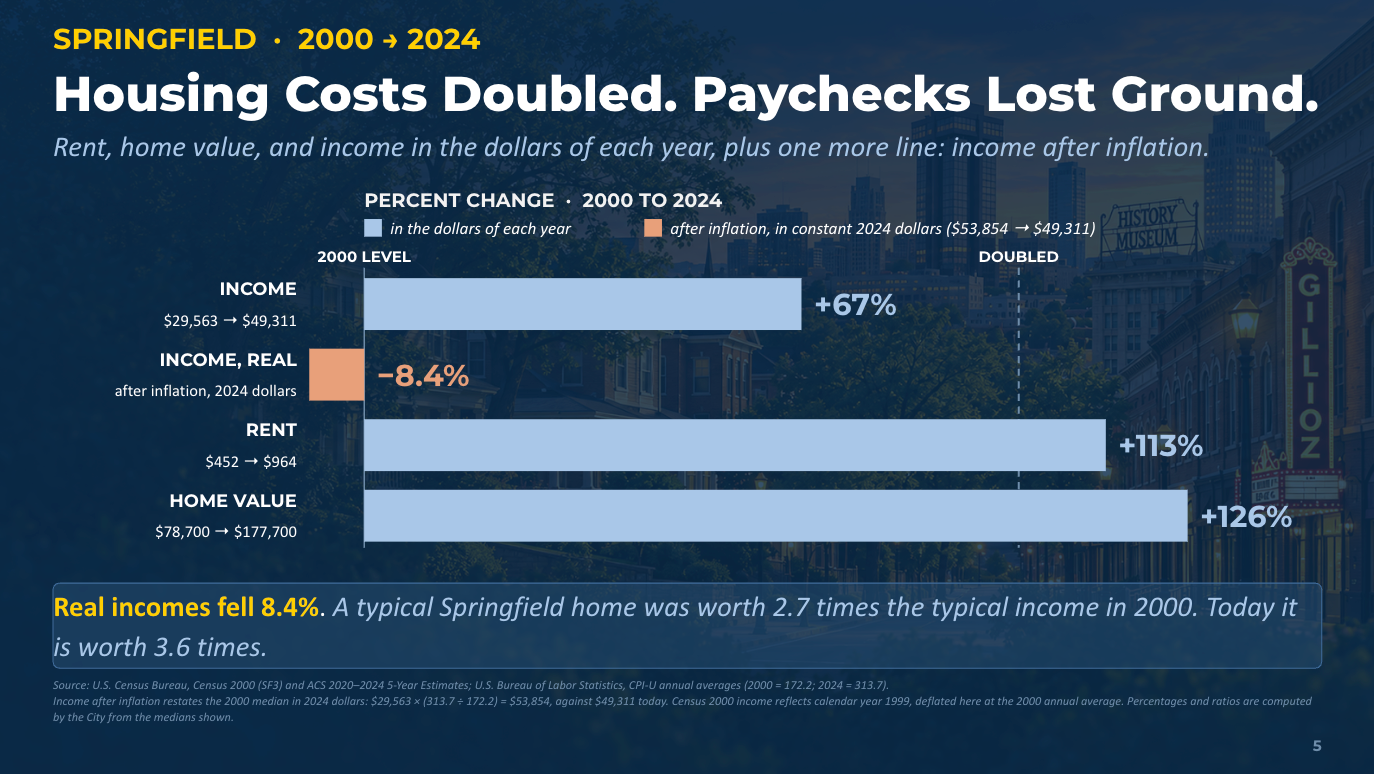
Springfield’s director of planning and development, Steve Childers, has begun to propose a new plan to revitalize the housing market that centers on a Community Reinvestment trust fund with an annual $10 million investment from the city. In a presentation given on September 17th to the nonprofit Restore SGF, whose mission is to improve home ownership and conditions in historic neighborhoods, Childers outlined both why the city is so uniquely vulnerable to the housing shortage and the necessary steps for it to be repaired.
The Springfield Advocate sat down with Childers last week to ask him how he thinks the city entered the housing crisis.
ADVOCATE: How did we get here? How did we get from that decrease in entry-level homes? Why do we have a lack of homes being built?
CHILDERS: The reason why we got here or one of the reasons how we got here is you have the number of households growing. Man, you have mom and dad and three kids. Okay, mom and dad and three kids make up one household. Then your oldest moves out. He goes and he lives with his buddy because he's going to college. That just created another household. Then you have the daughter move out. That created another household. Then you have the other daughter move out. Now you have four households where you used to have one household. The only problem is that three more dwelling units weren't created to accommodate those people that are looking for that. So we're not building housing units as fast as the people, as the buyer is or the renter that wants to live here, so you have people that want to be here, but we don't have enough dwelling units being created, so we have to create new dwelling units to do that. The problem with housing is it's very expensive, and because the cost of doing business has gone up, I mean, when you look at the cost per square foot, yeah, it's ridiculous.
Is that rise just due to the increase in building costs?
The increase in building costs has been a huge thing. Yeah, yeah. I mean, think about it, man. We're a HUD. We receive HUD funds. We are an entitlement city, therefore we get federal funding to provide affordable housing, not workforce housing, not attainable housing, but affordable housing. That's what it is. That's 80% and below. Workforce housing is 80% and above.
So the really high need, or the most needy is 30% and below. So you have different categories that HUD groups you in, but the fact of the matter is, our wages are low, and as the wages have remained the same, the cost of building has gone up. So for me as a builder, I can't go in and build houses and lose money. I mean, it has to pencil. Well, if I can't go into these neighborhoods and buy a lot and build a house that anybody can afford to buy, then why would I build that house? I'm going to go out and I'm going to go out into the green fields. I'm going to go out and build an Ozark and Nixa and some of these other places where the average household income is far greater, to where I can sell those houses, I have a market to go to. We don't really have a market, you know. And even if we have people that are demanding housing, we're not building the housing fast enough to accommodate them.
So you're saying we don't have a big enough market, and we're not creating new houses under 150,000 because our previous builders who used to do that are now in Nixa and Ozark?
If you built a house for $150 a square foot, and you built a 1000 square foot house, which isn't that big of a house, you have $150,000 in that house. That's just the house. That isn't the lot that you have to buy. That isn't the engineering that you have to do. That isn't the design that you have to create. The permits that you have to pull, that isn't in any of those things, and now you got to add a profit onto that, right? So I have to sell that $150,000 house for $180,000.
If I go into the neighborhoods that are here, the average house in some of these older neighborhoods is 88,000 to $100,000. Why? Who's going to go into that neighborhood and buy the nicest house in the neighborhood for $189,000 when the houses to the left and right of me are worth $100,000? I mean, it doesn't make any sense.
So, you have to somehow figure out a way to improve these neighborhoods and bring up the value of that, and we're talking about a lot of ways to do that, but the cost of building the house has gone up, the cost of buying the house has gone up, just everything. Wages have not kept up with that. That alone is your answer right there? I mean, people don't build houses to make money, and as far as trying to build more houses and losing money, well, that's called subsidy, and I don't know where anybody's going to get that subsidy because where does that come from? If it doesn't come from the federal government and it doesn't come from the state government, it's very unlikely that it's going to be able to come from the local government when the local government is just trying to be able to pay for roads and police and fire and sidewalks and parks and all those things. So how are they going to subsidize housing?
In that strain, you said we were an entitlement city. Have we seen any changes in our subsidizing from the federal government in the past few years?
No. The money that we're receiving isn't increasing; it's decreasing.
A lot of the problem with rent in particular is related to the missing middle you mentioned in your presentation. The duplexes to quadplexes that house a lot of a city’s workforce. Why don't we have this middle?
I really don't know. We're missing the missing middle big time. It is a product that every other city is pushing, and we're not, and we need to. I think this whole conversation about ownership versus rental has got a bad stigma to it. Look, not everybody wants to own a house, and not everybody needs to own a house. The average first-time home buyer now is 41, the highest it's ever been. These things are out of reach, and in bigger markets, they're very much out of reach. I'm all for somebody owning a house if they want one, but you have to start somewhere. If you're going to move out of your mom and dad's house, you may just have to go find a place to rent for a while just so you can get your feet under you and learn and figure out what you're going to do and find out what your job's going to be and then look around to figure out where you want to live and if you want to buy a house and can I afford that? You have an aging infrastructure, which is the actual house itself. A lot of people that own these, maybe they've owned them a long time, maybe they've inherited them. They don't have the means to fix it up, and the people, the landlords that do have them, if they do fix it up, they're going to have to raise the rent to compensate for the money they spent on it.
So you’re saying that every other city has that stock, right? Why? What's prevented us from creating that stock? Because they have the missing middle.
Our zoning code didn't change until April 2026 when we redid all of this. Forward SGF brought forward a lot of new ideas with regards to housing, and we saw this coming, and we knew we needed to do something about it, so we worked on it, and then we finally got the zoning in place.
What you did was you isolated different types of specific uses into very specific areas, meaning that when cities were built back in the 20s and 30s and so forth, you would have a single-family house next to a duplex, next to a fourplex, next to a corner store with three stories of residential apartments on top, and that was all mixed together. Different levels of socio-economic people live right next to each other. It was a blending. Well, then it was like, ooh, I'm going to get out, and we're going to have the urban flight. So we're going to create all of these subdivisions, and go out in the subdivisions, we're going to plat detached single-family houses. Everybody gets a lot. It's a really big lot, and I'm going to put one house on that lot because I can afford it. Things are affordable. Interest rates are reasonable. You know, money's coming in. People were doing well, so they could do that. Now you come to a place where we're at now, and everything's tightening back up. So we need to take the infrastructure that we have, which are the built cities, and we need to reinvest in density inside those cities. It costs far less to redevelop something you already have than going out to a farmer's field, plowing it all up, putting in brand new roads and curbs and gutters and storm waters and lights and signals and all those kinds of things. And having to give that to the public because once a developer does that, they hand all that over to the tax to the public, and when I mean that is that you and me and every other taxpayer gets to pay for that. So now there's just less peanut butter to spread on the bread.
Have there ever been discussions of trying to get those mixed-use area residential areas back?
We've been discussing it this last year, and we had a very aggressive rezoning map that we presented, and it didn't get approved as aggressively as we would have liked as staff proposed it. So there are still a lot of lots out there that could be rezoned to RMX one (a new zoning designation for duplex to quadplex introduced in March) to allow for a higher level density residential use in a predominantly single-family neighborhood.
Why was the conversation had this past year? Was there not talks beforehand, or trying to get the timeline?
I really don't know when the city started recognizing anything about its housing. I think that it's been talking about increasing its home ownership rate in the older neighborhoods for a while, but I don't think that it really said, wow, we've got a problem. And very clearly, you have an inventory problem. You need 20,000 new units in the next 10 years, and you have no way to build them. So you need to figure something out. And I'm not talking about single-family detached houses. I'm talking about everything. Single-family detached, duplex, triplex, fourplex, multifamily, whatever. Build it because that's what people are looking for. You can't have people move out of the five-bedroom, three-bath house that the mom, dad, and the three kids lived in. Now, mom and dad don't need that anymore. They could easily move to a two-bedroom, two-bath house with a two-car garage rather than a three-car garage. But there's really no option like that. So they're just going to stay right where they're at. The interest rate is low. We got it 20 years ago. Why would I move? I'll just add on a bonus room. I'll just stay right where I'm at. So you don't have people moving around as much as you used to either.
Especially now that interest rates are at 7%.
Exactly, and going up.
So who's actually responsible here? Who were the ones that you guys were trying to get this initiative passed by?
That's the planning and zoning commission and the city council.
And for whatever reason, I think, like I said, this conversation about ownership versus rental. I don't think you need less renters. I think you need a different level of renter. I don't know how we're going to tackle the affordable rental situation. Like I said, that requires large government subsidies. We, as a local community, nor any local community, can really afford to go subsidize that kind of housing. Maybe bigger cities that have just an entirely different economic structure could possibly do that, but not not at our level. So we're going to have to come up with a different way. We're going to have to keep working with our partners at the state and MHDC, the Missouri Housing Development Authority or Commission and try to get them to focus on housing. I haven't heard the federal government talking about housing at all. I mean, some of the senators and the ones that pass this bill are, but if it doesn't come with funding, then what’s it all for?
Would you say that right now we're in a housing crisis?
I think the whole country is in a housing crisis. I think we're just part of it. I don't know how unique it is, but we definitely have an additional layer of challenge in that our average household income is very low.
So to summarize what you're saying here, Springfield emphasized getting high home ownership among their residents, but now we find ourselves in a situation where home ownership is not a feasibility for most of the people who should be emerging into home ownership.
That's reality. I think it's fine that we have a goal as a city to try to find ways and create programs to build home ownership. I think that's going to be expensive, and I'm not saying we shouldn't do it. I'm saying I think it's going to be expensive, and I don't think that's going to solve your housing crisis, which is not having enough inventory.
Do you see more talk and enthusiasm among city council and the planning zoning commission for home ownership than for affordable housing?
I think they talk about home ownership a lot because I don't think they understand yet the full scope. I don't think there's a single agreed upon definition of what is the housing problem. I don't mean they don't understand. I just mean that we, as a city, need to say, ‘Look, you've got a problem, and your problem is an inventory problem.’
Springfield's housing problem is clear in my mind. Not enough inventory, not enough income, not enough options, and there's not enough redevelopment and reinvestment in the neighborhoods that we have. There's your problem, so solve it.

Only for news, not spam. Our data policy