I opened Forward SGF expecting another municipal document built to survive a committee meeting and then spend twenty years gathering electronic dust. Instead, I found Springfield’s chosen version of the future: hundreds of pages of parks, homes, streets, neighborhoods, jobs, utilities and hopeful renderings of people living their daily lives in a more pleasant Springfield.
The comprehensive-planning process began in 2019, and the plan was adopted in 2022 after nearly 10,000 points of public participation. It called itself a blueprint intended to guide the city for the next twenty years.
There was no chapter titled What to Do When a Landlord Wants to Put an AI Factory in a Medical Building.
Nobody involved in those workshops could reasonably have predicted the speed with which artificial intelligence would begin swallowing electricity, attracting speculative capital and sending developers hunting for old buildings and lightly defended substations. City officials have acknowledged as much. The planned development at 2900 South National permitted “data processing services,” but planning staff said that phrase was not the same thing as what we now understand to be a modern data center.
That distinction exposed the gap. The problem was not that Springfield had failed to imagine a desirable future. The problem was that it had not yet named the machine capable of consuming that future while claiming to comply with it.
Forward SGF’s organizing principle is Quality of Place. The phrase appears with the usual capital letters and civic polish, but beneath the branding lies a useful standard. Quality of Place is supposed to operate as the city’s “north star,” represented on our city flag and applied as a test to future growth, investment and public decisions:
Will this initiative improve quality of place?
The plan connects that idea to healthy neighborhoods, stable property values, environmental stewardship, public safety, attractive shared spaces and an economy that allows people to participate in a dignified life. New development is supposed to meet a higher standard, prioritizing “people, place, and prosperity.”
A data center fails that test before we even reach the technical details. A mostly sealed building whose primary activity is machines communicating with other machines does not create the kind of neighborhood center Forward SGF describes. It does not place homes, shops, parks and daily needs within walking distance. It does not produce a lively streetscape or meaningful public gathering place. It consumes land and infrastructure while offering few reasons for a person to approach it, enter it or remain near it.
The proposed South National project made the contradiction almost comical.
Offices upstairs, servers below: a thin layer of recognizable human activity laid over an industrial electrical operation. Enough desks to call it mixed use; enough computers to alter what the building materially was and, according to city officials, “kill all the trees in the parking lot.”
Forward SGF was built around a place-based approach. The data-center developer’s approach is load-based.
The city’s Land Development Code already contains nearly every principle needed to reject that method. Its stated purpose is to protect public health, safety and general welfare; secure the physical, social and economic well-being of residents; ensure compatibility among land uses; provide adequate water, wastewater and utilities; and distribute the costs and long-term maintenance of public services equitably.
Those are not decorative aspirations. They are supposed to govern what may be built.
A facility demanding extraordinary electrical capacity while producing relatively few permanent jobs raises an economic-welfare question. A facility requiring specialized cooling and continuous mechanical operation raises questions of compatibility. Backup generators, batteries and unusual electrical systems raise public-safety questions. Any project capable of forcing major utility expansion raises the question of who pays; not merely for its construction, but for decades of maintenance and risk.
The code even gives the city power to demand applicant-funded studies of infrastructure capacity, geology, hydrology, environmental effects, noise and fiscal impact. The tools were hanging on the wall. The city simply had no rule requiring officials to pick them up when somebody said the magic words data processing services.
That suggested the first necessary change, and perhaps the smallest: Name the use.
Springfield’s permanent code should define a data center according to what it does, not what the applicant chooses to call it. The definition should include any building, part of a building or group of structures whose primary operation is storing, processing, managing, transmitting or hosting digital information. It should explicitly include artificial-intelligence training, cloud computing, cryptocurrency operations and high-performance computing, along with the cooling systems, generators, batteries and electrical equipment necessary to keep them running.
Ordinary server closets in hospitals, schools and local businesses could be exempted below clear limits. A room supporting the work occurring inside a building is not the same thing as a building whose work is the operation of servers.
The moratorium had already moved in this direction. It established electrical and floor-area tests to determine whether digital processing was a building’s primary use. A permanent ordinance could refine those thresholds, but the central principle should remain: the law must look through the office furniture, marketing copy and architectural camouflage to identify the material operation underneath.
Then comes the second change: Place “Data Center” in the city’s land-use table and mark it prohibited.
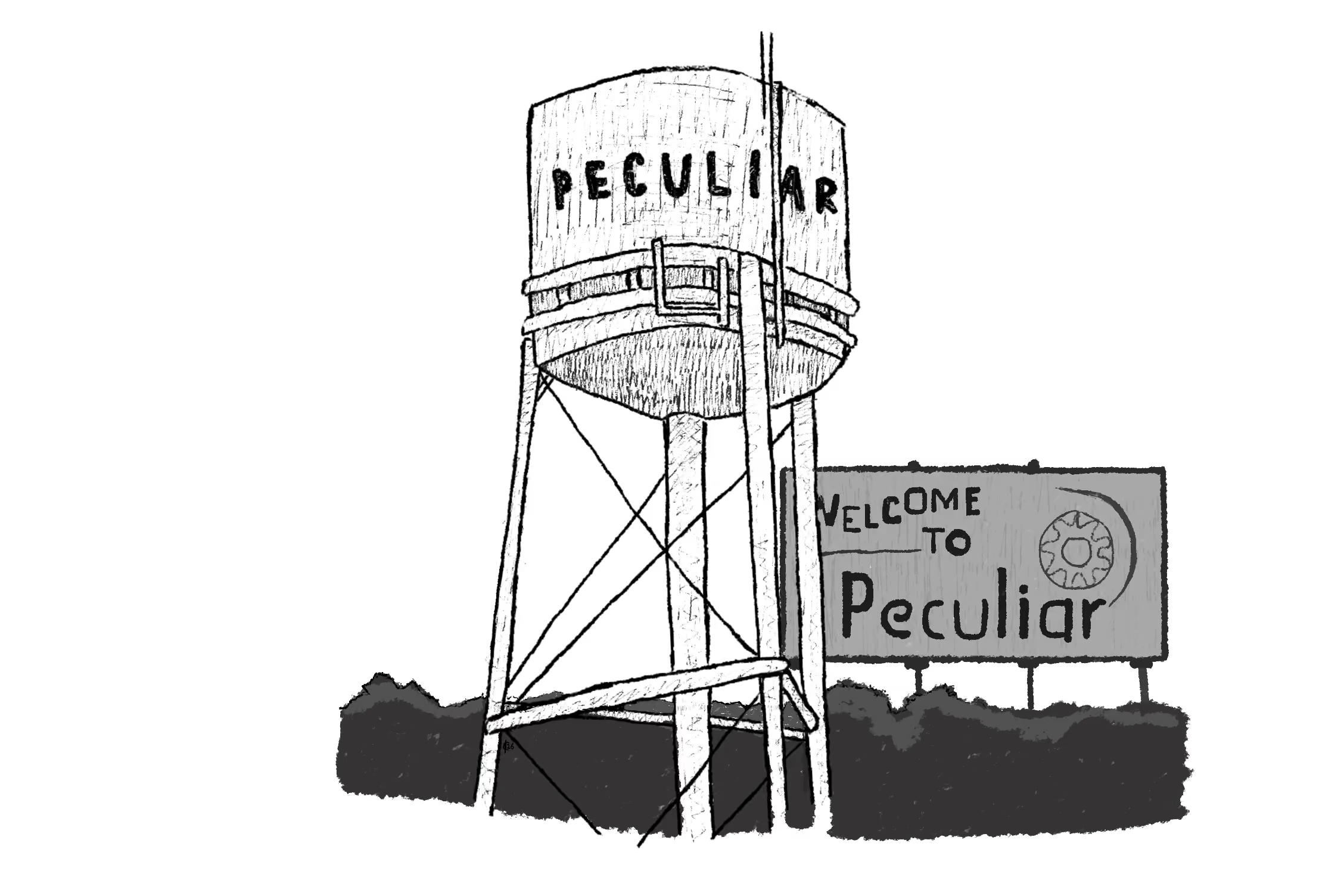
Peculiar demonstrated how little legislative machinery this can require. Its aldermen removed data centers as a permitted industrial use. Springfield could do the same without discarding or rewriting its entire comprehensive plan. Forward SGF itself called for continuing updates to the Land Development Code so that regulation would remain aligned with the city’s long-term vision.
The ban would apply to principles of Forward SGF, implementing a system of enforceable protections for our citizenry.
A third sentence would be necessary to prevent the English language from being deployed as excavation equipment again: A use meeting the definition of a data center shall not be approved or classified as an office, warehouse, research facility, telecommunications facility, utility use, data-processing service or accessory component of a mixed-use development.
Without that language, every prohibition becomes an invitation to rename the project. We had already seen the trick performed. Industrial became computational. Buildings became modules. A data center became a research facility. A massive electrical demand became stranded capacity waiting to be rescued.
The code must regulate the machine, not its costume.
The South National property presents the harder question because its planned development predates this controversy. Existing approvals and legally established uses cannot always be erased by passing a new ordinance. But permission for “data processing services” should not automatically become a perpetual entitlement to operate a modern AI data center, particularly when city staff themselves say those uses are not equivalent.
The permanent code should make clear that old, general language does not authorize a use whose scale and operational character were never considered. Any conversion, expansion or substantial increase in electrical demand, cooling capacity, generators or server space should trigger review under the new definition.
Existing lawful activity could remain within its actual historical scope without allowing a vague phrase written years ago to swallow every protection adopted afterward.
Forward SGF admits that no comprehensive plan can anticipate every issue. It describes itself as a framework that must be supplemented by future studies and regulatory updates as new conditions emerge.
Data centers are precisely such a condition.
We do not need to throw away the future Springfield spent years describing. We need to defend it from an industry that arrived after the public meetings ended. The residents who participated in Forward SGF asked for thriving neighborhoods, reliable infrastructure, environmental stewardship, quality employment and a city shaped around human life. They did not ask for public electricity, land and planning energy to be concentrated inside private surveillance factories whose economic value rests largely with distant owners.
The architects had designed the levee before anyone knew the flood’s name. They wrote public welfare, quality of place, compatible development, equitable infrastructure and protection of the Ozarks into its foundation.
They left one opening.
Closing it may require only a definition, a line in a table and the political courage to write one final word beside it: Prohibited.

Only for news, not spam. Our data policy