Artwork by Finley Crow
With over half of students and workers in the United States admitting to using artificial intelligence in their duties, questions about how AI should be used in the classroom, if it should be used at all, is a topic of discussions from lecture halls to conference rooms across the nation. At Ozarks Technical Community College (OTC), artificial intelligence’s role in their curriculum has been evaluated and policy drafted within select committees as faculty struggle to keep up with technology that grows in new directions every month.
Currently at OTC, no official comprehensive AI guidelines have been established, nor is the topic explicitly covered by the academic integrity policy. The rules are in the syllabi of courses, which vary between instructors. This approach was proposed in spring of 2024 at the same time that an internal body known as the OTC AI Advisory Workgroup ended their study of the topic. Such an approach, with no official policy on AI’s place in academic integrity, mirrors the state of other universities in Springfield at the time.
In a fall 2025 report comparing AI policies at Missouri’s universities by The Standard, Missouri State University (MSU) has not developed an AI policy. Similarly, Drury University’s academic integrity policy only mentions AI in reference to its unauthorized use as an example of violation.
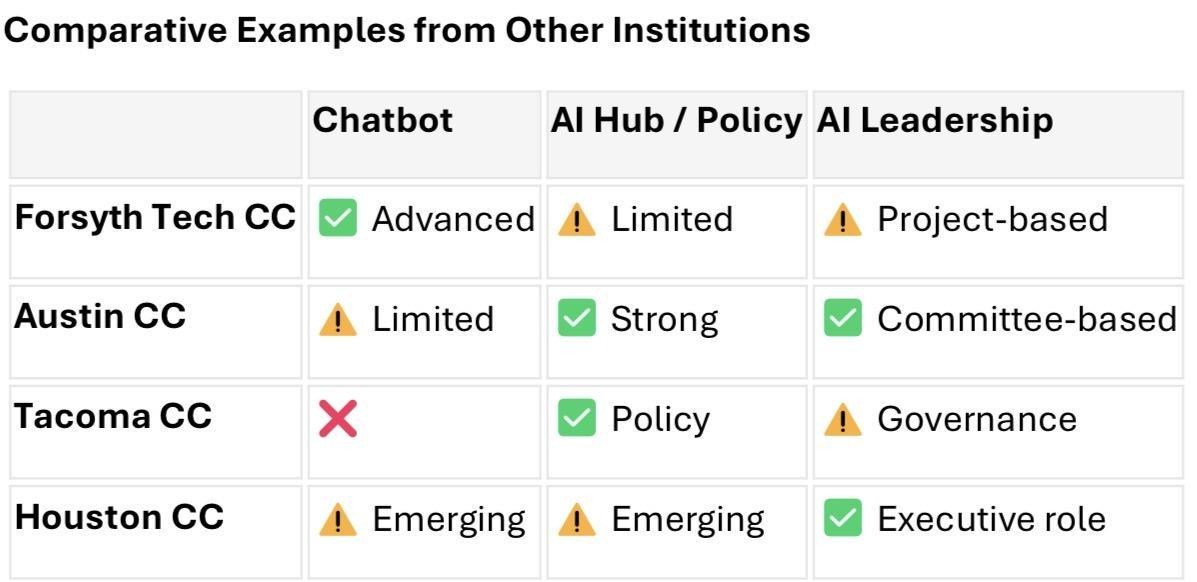
OTC began to deviate from its Springfield peers, however, when in June 2025 the college administration received an email. The institution was invited to join 29 other colleges in the American Association of Community College’s (AACC) “AI Skills for All” program. Funded by Microsoft, membership entitled the college to a $10,000 grant for AI development and expenses related to conferences. The expressed goal of this program was to “accelerate AI adoption” in an educational sphere that does not typically decide and adopt policy overnight.
“It’s [AI] a genie that is out of the bottle, and how do we then start helping our students prepare for a future where this genie is out, and we don’t know how far it will escape?” asks Andrew Aberle, Dean of Arts, Sciences, and Business.
Aberle was one of two faculty and staff members chosen to represent the institution in the “AI Skills for All” program along with Chief Technology Officer Eric Kyle, who was the school’s technical counterpart to Aberle’s academic perspective. The duo served to connect OTC to a national dialogue among community colleges on the topic of artificial intelligence.
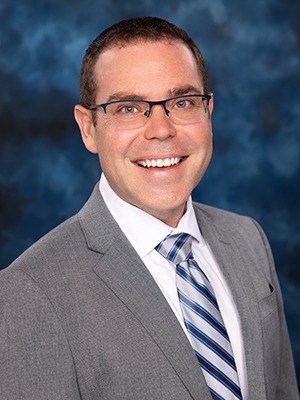
Aberle’s desk is covered in books about artificial intelligence and his personal copy of the school’s strategic plan booklet titled “Dream, Plan, Build” lays atop a tall pile of planning papers. Aberle has spent a year and a half thinking about how AI figures into OTC’s future. “This is our workplace Bible” says Aberle, opening the booklet to show his personal notes scrawled across the pages, “it’s going to be the thing that tells us where we’re going for the next five years.”
According to Aberle, this strategic plan, soon to be replaced by the similarly named “Building Our Future Together”, is the focus of countless discussions among faculty in the past two years who have often felt out of depth.
“Global higher education creates experts. Like you have your historians who are experts. You have your journalism experts. You have your experts in your fields, and these experts become known nationally. There’s no expert on AI.” says Aberle.
With no single voice to listen to, a new collective was established to receive the reports from Kyle and Aberle. This time headed by then College Director of Strategic Planning and Grant Development Calie Holden who explains that:
“This is just such a rapidly emerging technology [...] It’s just one of those topics that really impacts the college in so many different ways that we’ve taken many different approaches, this work group being one of them, of just kind of trying to learn more, continuing to investigate, especially as the technology continues to evolve.”
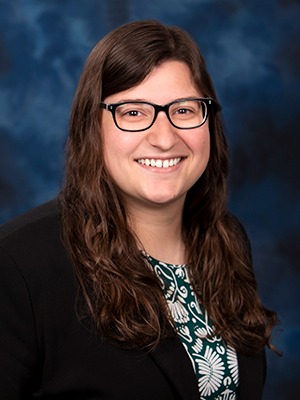
Composed of department chairs and program directors who were involved in previous efforts at examining AI’s impact, the new 15-person AI Workgroup began meeting monthly starting in September. Records obtained by The Springfield Advocate paint a picture of what these meetings looked like.
In the first email sent on July 21, 2025 to group members, Holden explained they were set out to achieve the goals of 1) recommending AI platforms and related policies, 2) developing resources to aid faculty in integrating AI into teaching practices and to help students, and 3) establish resources, recommendations, and trainings for how faculty and staff could use it in their respective roles. The group met every month for two semesters, sometimes breaking out into subgroups to discuss faculty & learning, staff, and policy.
In the course of their work, a faculty poll was conducted from February 2 to February 13 by the AI Workgroup. The Springfield Advocate also obtained this faculty survey and the data that was collected from it through a Missouri Sunshine Law request.
The survey quizzed faculty over what type of professional development or resources would most help them use AI in their job role, from student communication, detection of AI use in student assignments, support in administrative work, and using AI to improve teaching and student learning.
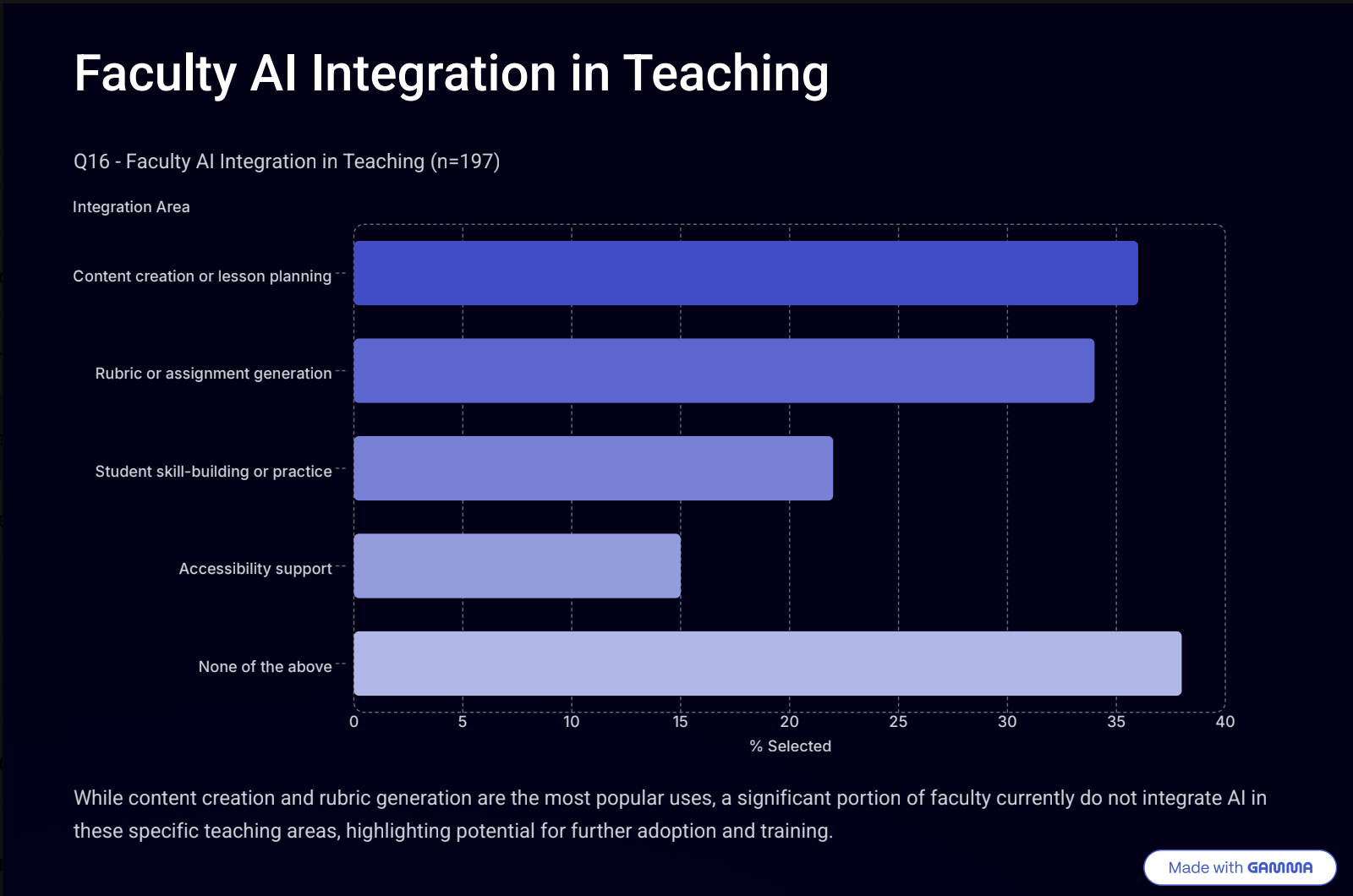
In the data collected by the polls and processed through Gamma AI by the Workgroup, faculty interest is apparent. Analyses revealed that 65% of those polled saw some or high value in AI being used. However, when it came to specifics, enthusiasm was less clear. The most selected figure under the question of where respondents believed AI could best be implemented showed that 37% of respondents selected “none of the above”. The second highest figure when prompted with the question showed that 35% selected content creation and lesson planning.
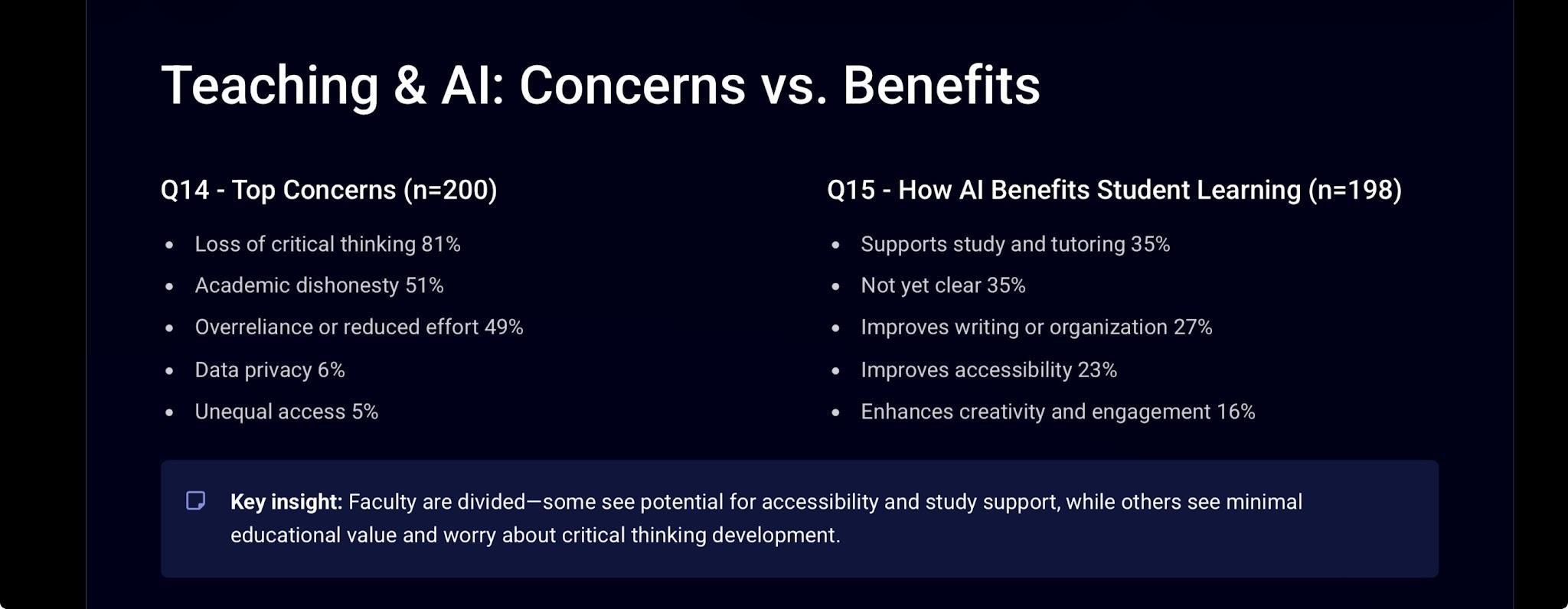
When prompted on their concerns with AI being implemented in education, the data was more unanimous. 81% of faculty had concern that AI would cause a loss in student critical thinking, and another 51% had concerns over academic honesty.
Both dissent and appreciation of the college’s integrative direction dominated the comments section of the survey. One response encouraged resistance, “I would love to see Ozarks Tech take a stand against AI use. I loathe that we have been made to believe it is inevitable and necessary.”
Another specified the target: “It would make me very proud to be part of an institution that stands up to the pressures of big corporations whose only goal is to make money at any cost, and instead believes in equipping and empowering our students to develop knowledge and skills necessary to improve our communities.”
Others embraced the resource-building project, “I teach for multiple schools and OTC has done the best job of educating adjuncts on Ai usage and has been very proactive about providing resources for those who want to learn more.”
Balanced voices intermingled the purely positive and negative comments: “AI can be beneficial; however, expectations need to be consistent and used in accordance with building professionalism in our students.”
Despite hesitancy and opposition, Gamma AI’s “Key Takeaways and Suggested Next Steps” focused on overcoming barriers to adoption. Recommendations included meeting people where they are, addressing ethics and policy, prioritizing practical use, and using a small AI assistant within the college’s website. “No part of our work group at this point really thought that there was any need to force people to use AI,” Holden clarified, “they just didn’t feel they had a lot of training in how to use AI.”
An example of this guidance is featured on a faculty-only page of the OTC website: “Teaching and Learning with Generative AI”. It asserts AI supports learning from enhancing assignments to instructional support. The website provides an exhaustive list of AI products to achieve these teaching goals. The college has also assembled the Generative AI Prompt Library for Staff and Faculty, which hosts 42 pre-written templates for administrative tasks, communication, and curriculum development.
During the process, OTC’s AI Workgroup, which handed off responsibilities to the provost this fall, did not directly reach out for student feedback at large on official policy in any special forum. Holden noted, “I would say we’re still having that conversation, and the student perspective is not going to be lost. We just might have not gotten there yet.”
Some students were, however, involved in a separate, highly selective AI panel organized by Aberle during the school’s winter holiday. Aberle reached out to several instructors across different departments in the fall semester of 2025 to ask that they recommend students for the panel. Six students were chosen and able to attend the forum, one of which was an alumni who was then attending Drury University.
The student forum was held as a part of a professional development day event on January 7, 2026. Teagan Bowzer, Student President of OTC’s Phi Theta Kappa chapter, was one of the students selected to attend that forum.
Bowzer stated that the forum was held to collect insight into the general student experience with AI in school, such as how it had thus far been implemented in lesson structure and assignment completion. “The forum was [for] how the workforce is changing and how you have to have some sort of experience with AI in a lot of these places, even jobs that you would assume that would be hands-on are moving towards the hands off approach,” stated Bowzer. According to her, the AACC-Microsoft initiative was not mentioned during this forum, which was the only one to have been held involving students to her knowledge.
Aberle looks fondly at the event as an opportunity to understand how AI is understood by those students looking to achieve the most. “What I was really looking for were thoughtful students who were thoughtful about and intentional about how they see AI impacting their education, and I really enjoyed that day. It was a great day to have students talk to the faculty. I felt like it helped the faculty see that we have amazing students and that they are intentional.” he said.
At an in-person meeting held this January during the AACC’s Workforce Development Institute, Aberle learned that this panel was an anomaly among the thirty universities represented when he asked about student participation:
“I asked, has anybody done a student panel? You know, has anybody done a student panel for faculty to hear from the students about how they’re using AI? What are the challenges that they’re facing with it? And nobody had volunteered that they had done it.”
During these developments, the chancellorship has had a hands-off approach. “I want it to be organic, I don’t want to run it myself,” stated Hal Higdon, Chancellor of Ozarks Technical Community College System in an impromptu interview. Although he has taken a hands off approach, Higdon has made his views clear: “Are you going to stop fire? Are you going to stop the wheel? Are you going to stop the industrial revolution? You’re not going to stop AI,” he was quoted saying at a panel conference on June 21.
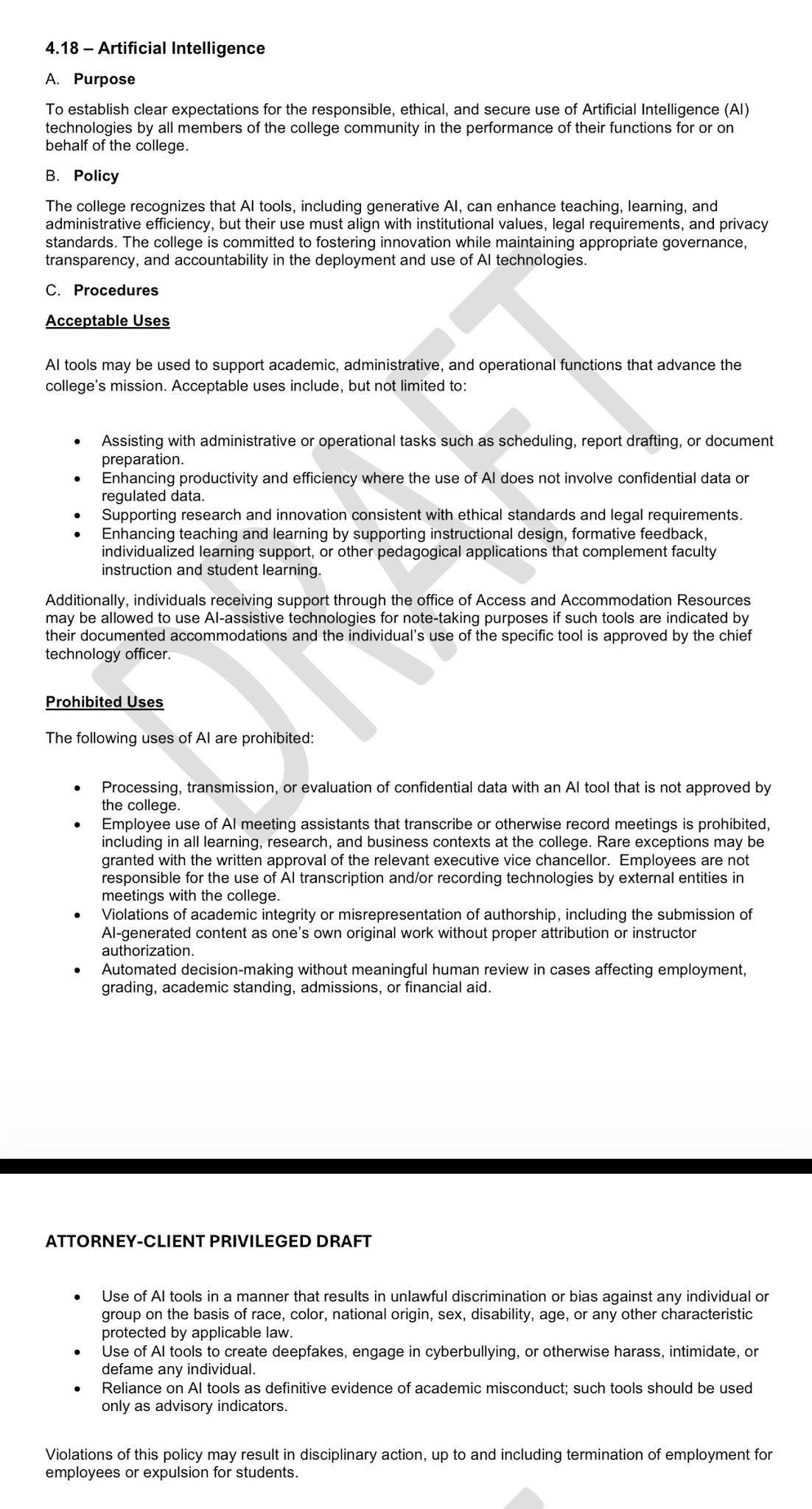
Without direct chancellorship involvement, progress continued. The Workgroup drafted a proposal that would add section “4.18 - Artificial Intelligence” to Article IV of OTC’s Policies and Procedures. It retains instructor discretion, but mandates that AI use is not required by students unless deemed necessary for learning outcomes. Baseline definitions are provided for instructors to reference.
Where the document is most expansive is in college-wide regulations. Acceptable use includes aiding in day-to-day tasks, supporting research, and developing curriculum. Prohibitions include processing data deemed confidential under federal and state law, record-keeping, and automating highly consequential choices affecting grades, employment, student applications, and finances.
Under current plans, the proposal pends approval from the Board of Trustees, which has not logged discussion of AI in its meeting minutes for the past five years. It is recommended to be reviewed during the 2029–2030 academic year.
Before the final review by the Board, the Workgroup has outlined a suggested timeline for the next steps to be taken by the Office of the Provost, Center for Academic Innovation (CAI), and Office of Academic Affairs. Student involvement is not mentioned, but Aberle and Holden encourage feedback through the strategic plan form.
Pointing to his copy of OTC’s strategic plan booklet again, Aberle emphasizes, “If this is a topic that you are very interested in talking about. Put it in here, in this, in the feedback for this, because then that means it becomes a focus of the college to be able to start having conversations around from a more intentional and bigger scale.”
If followed, these administrative groups will begin the process toward official policy this fall semester.

Only for news, not spam. Our data policy