35 members of the Black Student Union of Southwest Missouri State College raising their fists during their campaign to fire Dean of Women Toby Rives, February 1970. The poster reads: “Class Power”. [Ozarko, 1970, Southwest Missouri State College]
“Think. Think of millions of Black People huddled together in slums. Think of thousands of Black Men desperately looking for jobs. Their potential is limitless. Think of all the Afro-Americans in America working to their full potential and you will know what Black Power stands for.”
The above quote is not taken from a national leader or stripped out of The New York Times, but was printed in Missouri State University’s student newspaper The Southwest Standard. Its author, Willie Ward, belonged to the preeminent activist group on campus: the Black Student Union.
Although the most Springfieldians may know about local Black history is the Brown family presence and 1906 lynchings, this city experienced the barely discussed passions and dedication of civil rights and Black power activists. The NAACP Youth Council exposed discrimination to the public, but it was the Black Student Union (BSU) that forced reform at MSU.
Founded in October 1968, BSU spokespeople like James Brewer promoted the “Black Revolution” and the need for Black-centered education in Springfield Public Schools, Drury University, and MSU. The most public discussions were at PRIDE meetings, which formed out of Drury’s Sociology Club and a few of the 10 Black students enrolled that year.
With 80 Black students at MSU, the small cohort was empowered by national events and guest speakers. In February 1969, Dick Gregory, Charles V. Hamilton, and Romeo Martin exhorted the disruptive tactics of the Black power movement. When former Missouri legislator O.K. Armstrong lectured later that month at MSU, he condemned the movement as “lawless” and “terroristic”. His regret for doing “too much for civil rights” earned boos and counterarguments from the audience.
On April 28, BSU declared the first Soul Week and interrupted a Student Government Association (SGA) meeting. Its members charged that the cheerleader selection process, which chose zero Black applicants that year, was discriminatory. Although the SGA added two Black cheerleaders the same night, they were removed the following day.
The 3 all-Black sports teams declared a game boycott for next fall and together with the white leftist group RESIST, BSU initiated a sit-in. Outraged white students, many of whom were fraternity members and condemned BSU actions as coercive, responded with fistfights. The following day, 25 BSU members, some bearing baseball bats, had a standoff with nearly 200 white students. They dispersed once news of a democratized cheerleader selection process and 2 Black reservations was announced.
Success brought new demands of Black-inclusive curriculum, non-athletic scholarships, and African-American instructors. Instead of a boycott, in the fall came a new Black history course. Across school libraries, Black-authored books filled the shelves.
“We will not sit back and live like you want us to live and be like you would have us be. We demand, unyieldingly, respect and recognition of our dignity as men and women. We realize the severity of our accusations, but the truth is the truth and it must be heard.”
Knight's statement referred to an event that exemplified “subtle racism” and provoked BSU's second demonstration. On February 19, 1970, BSU President Ron Johnson and spokesperson Udo Gallop exposed Dean of Women Toby Rives for rejecting Cindy Murray’s application to the teaching program after Dean of Students Homer Bowman’s “recommendation with reservations”. According to BSU, Rives called Murray into her office a week earlier, telling her she was a “social deviant” as a white woman associating with Black men. They also claimed in a meeting with MSU President Arthury Mallory that he recognized the underlying prejudice.
Mallory, Rives, and other accuseds’ collective denial drew their ire. Quoting abolitionist William Lloyd Garrison, Johnson vowed, “We will continue to be as harsh as the truth and uncompromising as justice.” Tensions blew over on February 27 when Mallory and the Board of Regents explicitly refused BSU demands of firing or at least demoting Rives to professor. That night, the SGA declared the issue alive. BSU then called for a class boycott set for March 13.
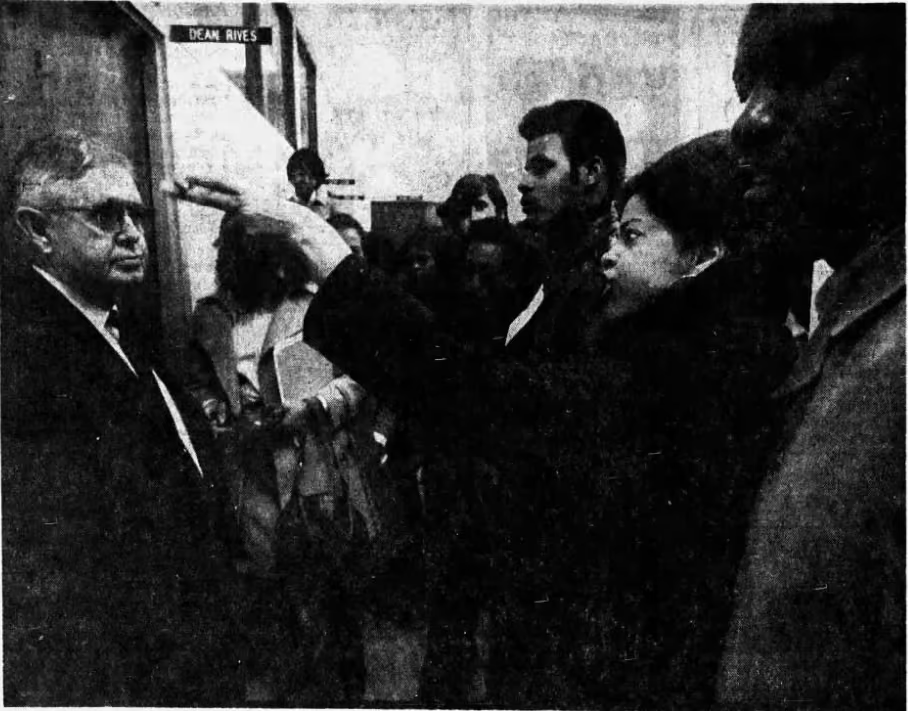
200 students participated in a march outside the Student Union chanting demands for “the truth” and debates with Rives, Mallory, and Bowman. Separate groups then marched to Rives and Mallory’s offices. Students were prevented from entering Rives’s office by Bowman, but pressure secured Mallory’s request for the Missouri Commission on Human Rights to investigate. The following spring, Rives resigned and returned to her native state of Texas.
A similar protest was prompted at Central High School on May 12. After being refused an Afro-American Society club and the district not implementing state-drafted Black-inclusive curriculum, a white band flew the Confederate flag at an election rally. Taunts were exchanged and a Black footballer punched a member. An hour later, another student retaliated against Henry Pratt, brother of the NAACP Youth Council president H. Wes Pratt.
The following day, 600 students committed to a walkout. Organized by the Youth Council, students sat out on a lawn before marching to city square. They were joined by Drury and MSU students.
6 points were presented by student leaders to the Superintendent including Black-inclusive curriculum overseen by a coordinator, Black teachers and security guards, inclusion on the cheer squad, and a ban on offensive imagery like the Confederate flag. Each demand was rejected except for the curriculum implementation. However, 3 years later even that proved inadequate with H. Wes Pratt claiming it was never followed on.
Inspired by the event and national events like the Kent State shooting and a riot in Augusta, Georgia, MSU marchers requested that their college have a day off classes for political and social discussion. Once rejected, they pressed their demands by disrupting classrooms in 3 buildings. A skirmish broke out in one interrupted by 3 BSU members including Udo Gallop (now Abu Bakr Ladd). Gallop pulled a knife but was quickly disarmed. Straightforward in his 2024 memoir, his belief was that of “cut[ting] off the hand that is slapping you” rather than turning the other cheek.
Fraternity members retaliated the same night of the incident by surrounding 3 Black men at the Student Union accusing them of planning a sorority panty raid. Among the crowd of 400 were bricks, bats, and ax handles. 6–9 police cars arrived on-campus to disperse the crowd, but rain was the deciding factor in the midnight near-brawl. The only damage came from a brick thrown at a police car and firebombing of the agricultural building.
Administration cracked down on the activists. Within a week, the Board of Regents and Faculty Senate amended policy to quicken prosecution of any future disruptors. Following an investigation, SGA approved the 3 BSU members’ admissions. However, Mallory, with the backing of the Board, personally rejected Gallop’s. He was then persecuted by police for the next two years until he fled in exile to West Africa.
Faced with stricter administration and violent peer reaction, BSU backed down the following year. Maintaining its demands but having lost its pressure tactics, it evolved into a social club over the years. Many of the first BSU generation moved away, having graduated or grown tired of white supremacy in Springfield.
From the movement’s ashes arose the beginnings of new educational leadership. In addition to the Black-inclusive curriculum and materials, the black-educator class, previously stunted by desegregation, slowly grew at MSU, Drury, and Springfield Public Schools. Numbering 13 in 1969, 200 minority teachers were employed by SPS in 2014.

Only for news, not spam. Our data policy