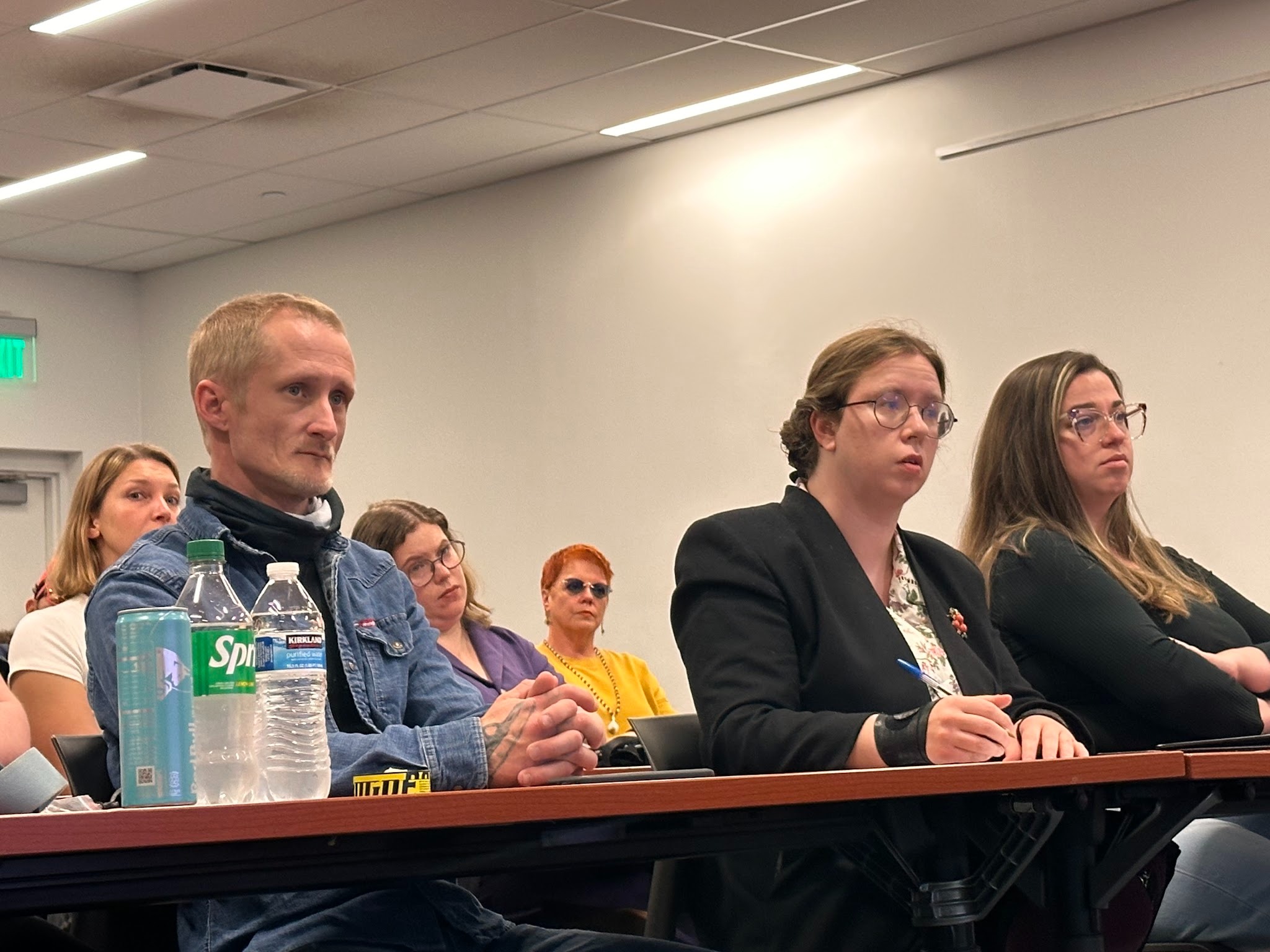
Michael Williams (right) speaks to a 28-member audience at the Schweitzer Brentwood Library. Traci Phelps stands at the podium, October 18, 2026. [Photo by Kelsie Bethune]
Surveillance has rapidly evolved since the turn of the century. Automatic license plate readers (ALPRs) such as Flock Safety have become a centerpiece in local politics. Two anti-Flock groups in Southwest Missouri united to explain how ALPRs have evolved from the list-based, letter scanners popularized in the 1990s to today’s AI-enhanced cataloguing.
Southwest Missouri law enforcement have joined a nationwide movement in spending millions of dollars in upgrading equipment through establishing contracts with private data-tracking corporations. Traci Phelps and Michael Williams with Flock Out SGF and DeFlock Joplin, respectively, trace the phenomenon’s origins to the post-9/11 landscape. On October 18, they presented a history of surveillance technology and contemporary products used nationally and locally to a 28-member audience at the Schweitzer Brentwood Library.
Phelps holds a master’s degree in cybersecurity from Western Governors University. Williams holds a bachelor’s in computer forensics from Missouri Southern State University.
They explain that the September 11, 2001 attacks prompted the U.S. government to pass legislation to expand monitoring. Phelps and Williams pointed to the Patriot Act (2001) as the start.
Spending on surveillance technology skyrocketed. Data-sharing between law enforcement, the Department of Homeland Security, and Department of Justice melded through fusion centers. As of 2021, the total operating cost for 78 of the 80 centers was $403 million.
These centers, alongside the locally-based Regional Information Sharing Systems (RISS), aid in the national coordination between law enforcement. In 2025, RISS was allocated $38.8 million in funding, split between six regional headquarters. Springfield hosts one such location: the Mid-States Organized Crime Information Center (MOCIC). The same year, Missouri had 410 agencies opted in and 35,507 RISS database inquiries.
Government databases and private companies’ have been merging through product adoptions by law enforcement. Rather than station-stored databases, information is uploaded to cloud systems such as RISS and Amazon Warehouse Services (AWS).
“It’s definitely not like it used to be like a lot of law enforcement are casting it off as,” Phelps asserted. Businesses and local governments alike can opt into sharing data from Axon-owned Fusus cameras. “In 2023, the EFF [Electronic Frontier Foundation] reported there were only 150 jurisdictions that used it; now there’s 324. And in Georgia alone, 275,000 [cameras are in use].”
Phelps has tracked the Springfield Police Department’s use of AI-enhanced technology through Missouri Sunshine Law requests. Her findings reveal that since 2025 SPD has used:
She found that the Flock funding, like Joplin as Williams shared, comes from grants part of the Missouri Blue Shield Program. Clearview AI, which is also contracted with Immigration Customs and Enforcement (ICE), is funded by the Edward Byrne Memorial Justice Assistance Grant. She responded to an audience question by saying, “At city council they’re not voting: oh, should we get Flock cameras? They’re voting to approve a grant, and it’s a line item on that grant. The public doesn’t know what these line items are, and then it goes through.”
Williams noted, “In Joplin, they say that the police followed the rules to make the purchase for Flock. I tend to disagree, but even if they did, my question is, should the police be allowed to install a mass surveillance system without getting democratic approval? I kind of think no.”
Yet their data is incomplete. Phelps added, “I don’t have a vendor list from the city yet. I put in a Sunshine request. I’m sure they’ll stick to it someday just like my other ones that are sitting out that I paid for.”
Williams was open about his struggle as well, “I got most of the grant applications. Most of them are pretty standard run-of-the-mill stuff, but a lot of them were just inextricably redacted. And after going through all of them and putting the patterns together, I realized all the ones that were missing were the Flock funds.”
Phelps commented on SPD’s latest adoption, an initial payment of $5.3 million for a 10-year contract for Axon body cameras, “I do believe that body cameras are good. Do they need body cameras that write reports for them and are AI-enhanced and owned by a private company? Probably not,” adding, “There is a lot of money being spent and a lot of money being made on our data, on our lives.”
Williams predicts all of its body camera footage will become searchable in the near future: “A lot of people rightfully think we should have them for accountability purposes … They will go into the Axon backend…” He clarifies, “That might not be concerning in Springfield, where most times you interact with a police officer, it’s because they pull you over. But in a lot of cities, there’s cops just walking around, and you are going to be caught on camera through no action.”
The pair concluded with paths for resistance. Five audience members were awarded through raffle tickets homemade counter-surveillance trackers known as “biscuits”. They are capable of tracking signals emitted via Wi-Fi, Bluetooth, and radio. Attendees were warned to consensually use the tool on devices, if not only their own.

Only for news, not spam. Our data policy